
 Jeffrey Xiong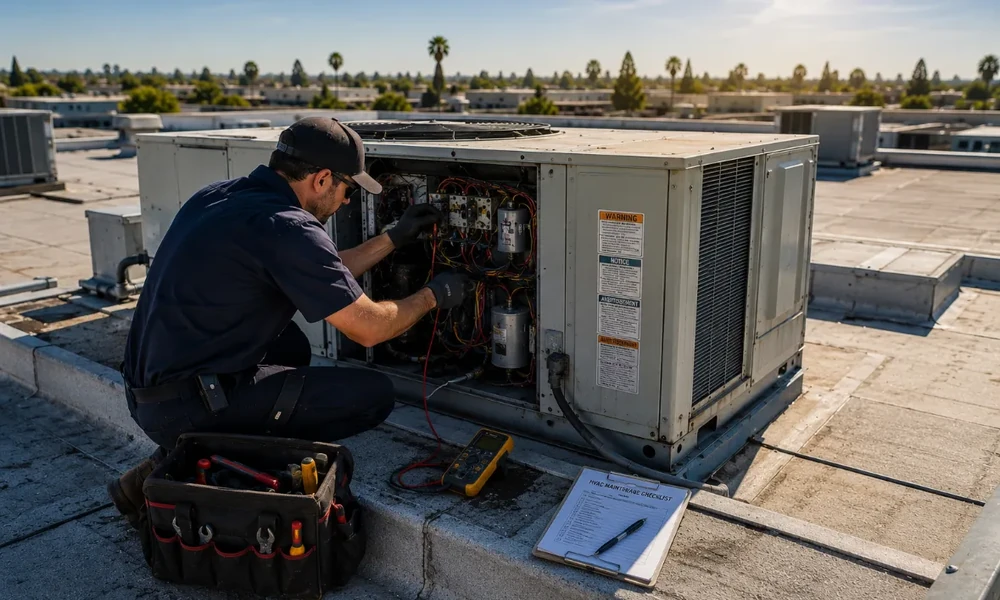
Most rooftop units in the South do not die in July. They die in February, quietly, and July just makes it official.
That is the part nobody puts on a work order. Heat and humidity get blamed because that is when the compressor finally quits and your dining room hits 84 degrees by noon. But the failure started months earlier, in a season when nobody was thinking about cooling at all. If you own or manage a restaurant, a warehouse, or an office building, your building’s cooling system has a clock running on it right now, and humidity is speeding it up. If your building already runs on a commercial heating and cooling maintenance plan, you’re ahead of most owners. If it doesn’t, this is the article that explains what you’re actually risking.
Here’s what I’ll walk you through: why Southern humidity wrecks equipment in ways dry climates don’t, the warning signs worth writing down, and a decision framework you can use to figure out whether a service contract is worth your money or just another line item.
Humidity Is the Part Nobody Budgets For
Air conditioning does two jobs at once. It cools the air, and it pulls moisture out of it. Relative humidity around 50 percent is the mark most comfort standards aim for. When outdoor air sits at 80 or 90 percent humidity in August, your equipment is working double shifts.
That second job is the expensive one. Every drop of water the coil pulls out of the air takes energy, and a system sized for a dry climate gets pushed past its design limits in a humid one. According to the Department of Energy, heating and cooling typically accounts for the largest share of a commercial building’s energy use, which means every extra hour your compressors spend fighting moisture shows up on a utility bill you already dread opening.
What does that look like in practice? I’ve watched a kitchen exhaust hood pull humid outside air straight across a rooftop unit’s return, all day, every day. The coil never gets a chance to dry out. Mold creeps into the drain pan. The blower motor rusts at the shaft. None of that requires a heat wave, and none of it gets caught by a thermostat reading.
Three Warning Signs You Can Catch Before the Breakdown
Your staff notices these before any diagnostic tool does. Give them a place to report what they see.
- Condensate where it shouldn’t be. Water stains on a ceiling tile, a puddle near a floor drain, or a drip pan that fills overnight all point to a clogged drain line or a coil that isn’t draining right. That water has to go somewhere, and gravity always wins.
- Longer run times in mild weather. If the unit still runs at 7 p.m. on a 78 degree day, it’s losing capacity. Could be refrigerant, could be a dirty coil, could be a failing compressor. You won’t know until someone puts gauges on it.
- Uneven temperatures across zones. One office is cold, one is stuffy, and the thermostat sits in the corner that’s fine. That usually means airflow, not thermostat settings.
Write these down with a date and a location. A technician who walks in with three weeks of observations finds the problem in an hour instead of a full afternoon. That matters for your bill, and it matters when you’re trying to explain to a landlord why the unit failed.
The Months That Matter Most
Spring and fall are when equipment earns its keep, and most owners use them to do nothing. I’d argue those two windows are worth more than any emergency call you’ll ever pay for, because they’re the only times you can catch problems without a line of customers waiting on you.
For a Southern building, the spring visit is about getting the coil clean and the drains clear before the first real heat wave. The fall visit is about the heating side and the changeover, when a heat pump that sat idle for six months gets tested before it matters. Skip both, and you’re rolling dice on a machine that hasn’t been inspected in a year.
There’s a reason this rhythm exists. The organization behind most commercial building standards, ASHRAE, publishes guidance that distinguishes between routine upkeep and the kind of planned service that prevents failures rather than reacting to them. The distinction isn’t marketing language. It’s the difference between a technician who finds a loose electrical connection in April and one who finds a burnt contactor in August.
Repair, Replace, or Contract: A Decision Framework
Owners ask me the same question every summer: should I fix it, replace it, or sign up for a service plan? I use a simple rule I call the Three-Hits Test. If the same unit has needed three separate repairs in eighteen months, replacement math starts winning. If it’s one repair on a well-maintained unit, fix it and move on. If you can’t remember the last time anyone looked at it, that’s your answer.
Here’s the breakdown in plain terms:
| Situation | What I’d Do | Why |
|---|---|---|
| Unit under 10 years old, one repair | Repair, then schedule a spring visit | Cheaper than replacement, and you get eyes on it before next cooling season |
| Unit over 15 years old, repeated failures | Get replacement quotes now, not in July | You want choices, not an emergency purchase at whatever price is quoted that day |
| Multiple units, mixed ages | Stagger replacements, keep the rest on a plan | Spreads the capital hit and keeps some capacity online during changeout |
| Building runs on thin margins, no reserve | Service contract, minimum twice a year | A planned visit costs less than a shutdown during your busiest week |
One caveat: a service contract only helps if the technician actually does the work. Ask what’s included, how long a visit takes, and whether you get a written report afterward. A fifteen-minute filter change dressed up as “preventative maintenance” is worse than nothing, because it gives you false confidence.
Indoor Air Quality Is Your Second Reason
A failing coil affects more than your electric bill. When moisture sits in a system, microbial growth follows, and the air your employees and customers breathe comes out of the same ducts. According to the Environmental Protection Agency, indoor air can carry higher concentrations of some pollutants than outdoor air, and a building’s air handling equipment is a big part of why. For restaurants and offices, that’s a practical concern, not a theoretical one. Sick employees and complaints about stuffiness cost real money.
Your maintenance plan should say something about coil cleaning and drain care for exactly this reason. If a provider only talks about filters and refrigerant, ask harder questions.
What to Put on Your Calendar
Here’s the short version you can act on this week.
- Walk your building and write down every unit, its age if you can find it, and any water stains or odd noises you notice.
- Ask your staff to report temperature complaints in writing, with dates.
- Schedule one visit before the first hot stretch of the year, and one before the first cold one.
- Get the written report after each visit and keep it. That history is how you prove a unit’s condition at replacement time.
Humidity isn’t going anywhere in the South, and your equipment can’t opt out of doing two jobs at once. The owners who avoid August emergencies aren’t luckier than you. They just refused to let February pass without a plan. Which month are you in right now?